





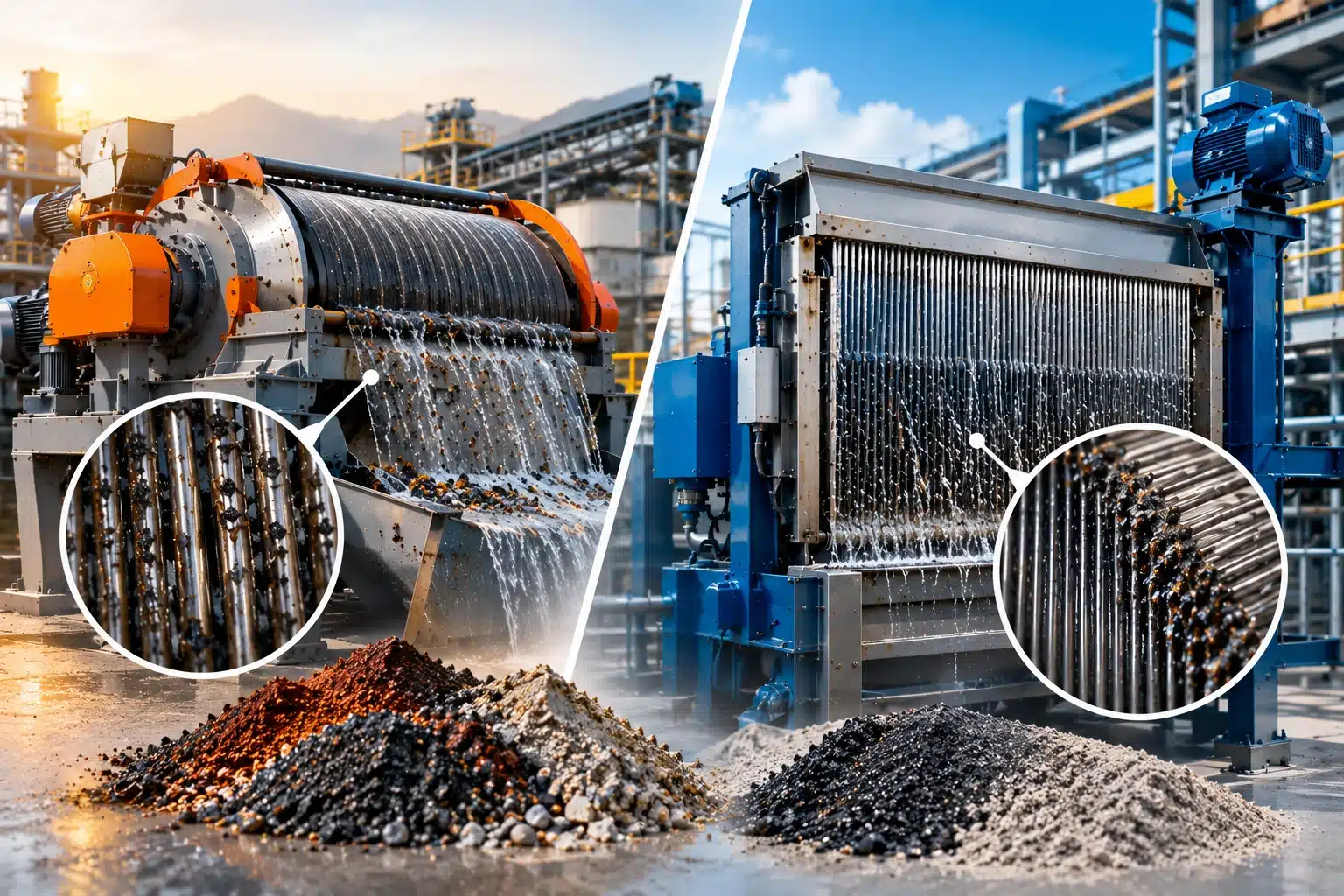
A Practical Guide to Choosing Magnetic Separators for Weakly Magnetic Minerals and Fine Particles
Introduction
In many Material Transfer & Handling Equipment, conventional magnetic traps may not provide sufficient separation when the target mineral has weak magnetic properties or when valuable material has been liberated into fine particle sizes. In these situations, two technologies are commonly considered: WHIMS and HGMS.
Both technologies are designed to separate paramagnetic and weakly magnetic minerals from non-magnetic materials. However, they differ in terms of magnetic field configuration, matrix design, slurry flow, and process sensitivity.
So, what is the difference between WHIMS and HGMS, and which technology is more suitable for materials such as hematite, limonite, ilmenite, chromite, kaolin, feldspar, or silica sand?
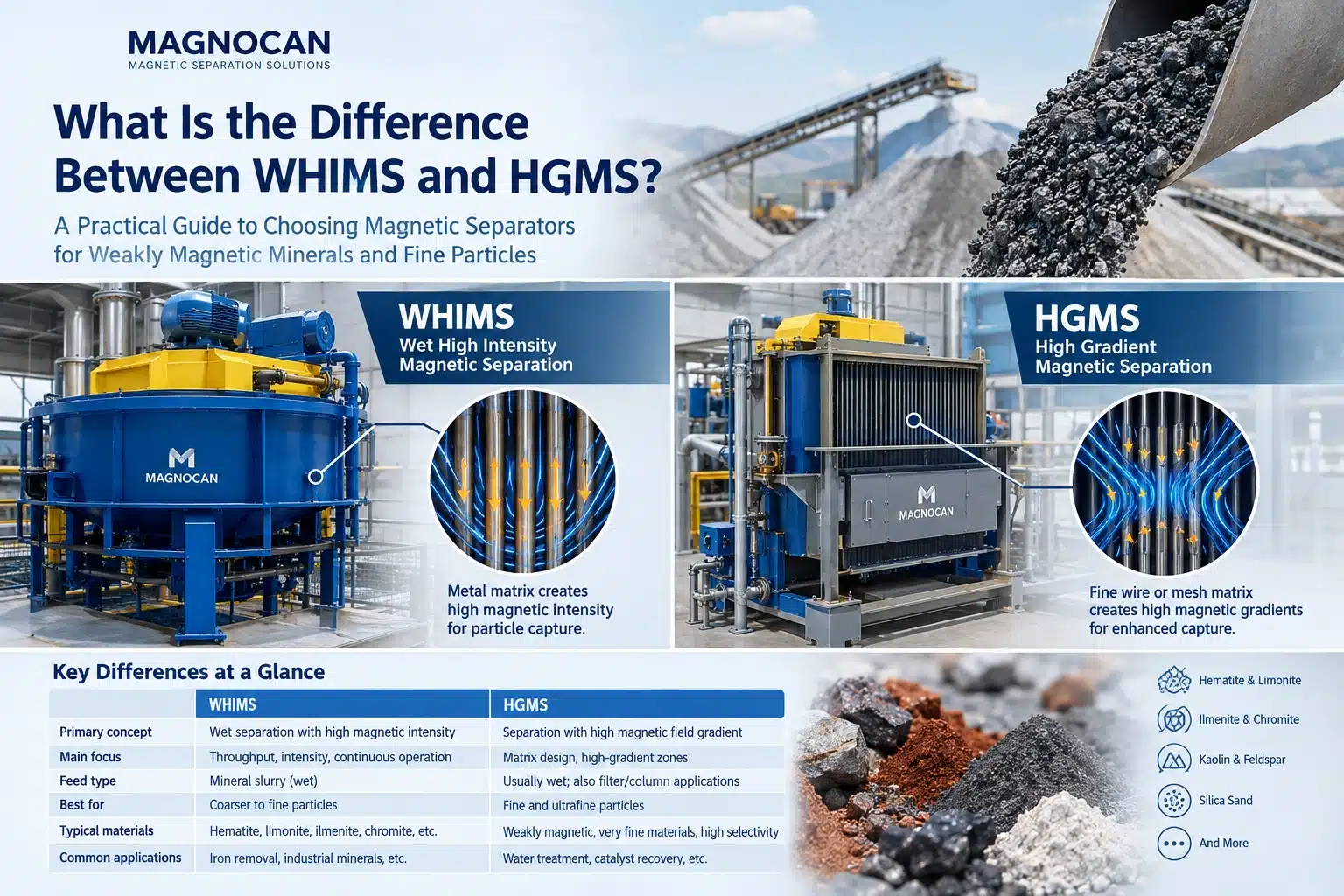
The short answer is that the boundary between these two terms is not always completely distinct. WHIMS (Wet High Intensity Magnetic Separation) describes a family of wet magnetic separation systems operating at high magnetic intensity, while HGMS (High Gradient Magnetic Separation) focuses on generating a very high magnetic field gradient around a magnetic matrix.
As a result, many advanced WHIMS systems also incorporate HGMS principles.
How Does High-Intensity Magnetic Separation Work?
The force that attracts a mineral particle toward a magnetic region does not depend solely on magnetic field intensity. It is also influenced by the particle’s magnetic susceptibility, volume, magnetic field strength, and, most importantly, the change in magnetic field over a short distance, known as the magnetic field gradient.
A strong magnetic field does not necessarily guarantee effective capture if there is insufficient field gradient within the separation zone. This is particularly important for very fine or weakly magnetic particles.
Steel matrices, rods, grooved plates, or ferromagnetic fibres can concentrate magnetic flux lines and create localized areas with high magnetic field gradients. These high-gradient regions increase the probability of capturing weakly magnetic particles.
In a wet separation circuit, the feed enters the separation zone as a slurry. Magnetic or paramagnetic particles are captured by the matrix, while particles with a weak magnetic response remain in the slurry and pass through the system.
The matrix is then moved out of the magnetic field, or the magnetic field is switched off, allowing the captured particles to be released and washed away.
Separation performance depends on several operating factors, including:
- Particle size distribution
- Solids concentration
- Slurry flow rate
- Magnetic field intensity
- Matrix design
- Matrix configuration
- Washing conditions
What Is WHIMS?
WHIMS stands for Wet High Intensity Magnetic Separation.
WHIMS equipment is commonly used to recover minerals that have a weaker magnetic response than magnetite but can still be separated under high-intensity magnetic fields.
WHIMS systems can be designed in different configurations, including:
- Vertical ring separators
- Horizontal ring separators
- Carousel-type systems
- Pulsating magnetic separators
These systems commonly incorporate a magnetic matrix to enhance the separation of weakly magnetic particles.
One of the key advantages of WHIMS is its ability to operate continuously at industrial capacity while processing mineral slurries at relatively high throughput.
WHIMS technology is commonly applied to:
Hematite and limonite beneficiation
Ilmenite and fine chromite recovery
Iron removal from kaolin and feldspar
Silica sand purification
Industrial mineral processing
In vertical-ring and pulsating configurations, controlled slurry movement and water pulsation can help prevent excessive matrix compaction, release trapped non-magnetic particles, and reduce matrix blockage.
What Is HGMS?
HGMS stands for High Gradient Magnetic Separation.
The primary focus of HGMS is the creation of very small regions with a steep change in magnetic field intensity.
This is typically achieved by directing the magnetic field through a matrix containing elements such as:
Fine wires
Steel rods
Mesh
Steel wool
Special magnetic plates
The edges and surfaces of these matrix elements create areas where the magnetic field gradient can increase significantly.
HGMS is particularly useful for fine and ultrafine particles and materials with relatively low magnetic susceptibility.
In addition to mineral processing, HGMS principles can be applied in areas such as:
Water treatment
Removal of iron-bearing particles
Catalyst recovery
Selected chemical processing applications
However, finer matrix structures can also increase the risk of matrix blockage, pressure drop, and mechanical trapping of non-magnetic particles. Proper feed preparation and process control are therefore critical.
What Is the Main Difference Between WHIMS and HGMS?
The fundamental difference can be understood by looking at what each term describes.
WHIMS primarily describes the separation process and operating environment: it is a wet separation process that uses a high-intensity magnetic field.
HGMS focuses on the mechanism used to increase magnetic capture force: a very high magnetic field gradient is created around the matrix.
Therefore, a single magnetic separator can incorporate both WHIMS and HGMS characteristics.
For example, a pulsating vertical-ring separator operating in a wet environment may use a high-intensity magnetic field together with a rod-based matrix designed to create high magnetic gradients.
| Criteria | WHIMS | HGMS |
| Primary definition | Wet separation using high magnetic intensity | Separation using a high magnetic field gradient |
| Design focus | Magnetic intensity, throughput, and continuous operation | Matrix design and creation of high-gradient zones |
| Feed type | Mineral slurry and wet feed |
Usually wet; specialized filter or column applications are also possible
|
| Particle size | Fine to relatively coarse, depending on matrix design | Particularly fine and ultrafine particles |
| Typical materials | Hematite, limonite, ilmenite, chromite, manganese, industrial minerals |
Weakly magnetic particles, very fine materials, and feeds requiring high selectivity
|
| Operational considerations | Matrix blockage and recovery variations caused by feed changes |
Greater risk of blockage and pressure drop with fine matrices
|
| Capacity | Generally suitable for high industrial throughput |
Laboratory to industrial scale, depending on matrix and washing cycle
|
| Relationship | May incorporate high-gradient principles | Can be implemented within a WHIMS system |
Why Is Magnetic Field Intensity Alone Not Enough?
One of the most common mistakes when selecting a high-intensity magnetic separator is comparing equipment based only on its Tesla or Gauss rating.
Background magnetic field intensity provides important information, but actual separation performance depends on the interaction between:
- Magnetic field intensity
- Magnetic field gradient
- Matrix material
- Matrix geometry
- Distance between matrix elements
- Particle residence time
- Slurry hydrodynamics
Two magnetic separators with similar magnetic field intensity can produce significantly different recovery and concentrate grades when processing the same feed.
For very fine particles, reducing particle mass also reduces the available magnetic force acting on the particle. Under these conditions, increasing the magnetic field gradient around wires or matrix rods can improve particle capture.
On the other hand, if slurry velocity is too high or solids concentration is not properly controlled, hydrodynamic forces can overcome the magnetic attraction acting on the particles.
For this reason, magnetic separator selection should be based on process testing rather than catalogue specifications alone.
Common Applications of WHIMS and HGMS
In the processing of oxidized iron ores, these technologies can be used to recover minerals such as hematite, martite, and limonite from tailings or ground feed.
High-intensity magnetic separation can also be used in the processing and upgrading of:
- Ilmenite
- Chromite
- Manganese
- Tungsten
- Feldspar
- Quartz
- Silica
- Kaolin
- Nepheline syenite
For industrial minerals such as feldspar, quartz, silica sand, and kaolin, the objective is often to remove iron-bearing particles and improve product purity, brightness, or overall quality.
HGMS can be particularly attractive when contaminant particles are extremely fine or have low magnetic susceptibility.
However, large amounts of slimes, clay, sticky particles, or strongly magnetic minerals in the feed can cause the matrix to become saturated or blocked.
Depending on the feed characteristics, pretreatment such as desliming, classification, washing, or low-intensity magnetic separation (LIMS) to remove magnetite may be required before WHIMS or HGMS.
What Factors Should Be Considered When Choosing Between WHIMS and HGMS?
The correct selection process should begin with an understanding of the mineralogy of the feed.
Identifying the type of iron-bearing mineral, degree of liberation, particle size distribution, and magnetic susceptibility is often more important than simply choosing a particular equipment name or configuration.
The objective of the separation circuit should also be clearly defined.
For example:
Is the priority maximum recovery?
Is the goal to increase concentrate grade?
Is the objective to reduce iron contamination in a non-metallic product?
Is the goal to recover valuable minerals from tailings?
As a general starting point:
For industrial-scale, wet feeds with a relatively broad particle-size distribution, a continuous WHIMS system with an appropriate matrix may be a suitable option.
For very fine, weakly magnetic particles requiring high localized magnetic attraction, an HGMS design or a high-gradient WHIMS system may warrant further evaluation.
For feeds that are prone to matrix blockage, vertical-ring designs, reverse washing, and pulsating mechanisms may help improve operating stability.
If magnetite or strongly ferromagnetic particles are present, a low-intensity magnetic separation stage may be considered first to prevent premature saturation of the high-intensity separator matrix.
Laboratory and pilot testing should evaluate recovery, grade, water consumption, pressure drop, capacity, and matrix washing performance together.
Important Operating Variables
Magnetic field intensity, matrix type and spacing, slurry flow rate, solids concentration, feed particle size, residence time, wash-water quality, and pulsation frequency are among the most important operating variables.
A finer matrix generally produces a higher magnetic field gradient, but it also reduces the available flow area.
Increasing magnetic field intensity may improve recovery, but it can also capture additional low-value or gangue particles and reduce concentrate grade.
The optimum operating point should therefore be determined through testing.
Monitoring the following parameters is important for maintaining stable performance:
Pressure differential
Slurry flow rate
Concentrate quality
Tailings quality
Matrix washing condition
Feed composition
Solids concentration
Slimes content
A sudden change in feed composition, solids concentration, or slime content can alter the balance between magnetic and hydrodynamic forces.
Regular sampling and operational data recording can help identify performance degradation before it develops into an equipment shutdown or a significant loss in recovery.
Common Mistakes When Comparing WHIMS and HGMS
1. Assuming HGMS Is Always a Separate Type of Equipment
HGMS is not necessarily a completely separate equipment category from WHIMS. Many modern WHIMS systems use high-gradient magnetic matrices.
2. Selecting Equipment Based Only on Maximum Magnetic Field Intensity
The highest advertised magnetic field does not automatically provide the best separation. Magnetic gradient, matrix design, slurry flow, and feed characteristics are equally important.
3. Ignoring Feed Preparation
Sending feed directly to WHIMS or HGMS without appropriate desliming or removal of strongly magnetic particles can increase matrix blockage and negatively affect performance.
4. Applying Results From One Mineral to Another
The magnetic response of hematite, chromite, kaolin, and silica is not the same. Separation results from one mineral system should not automatically be applied to another.
5. Ignoring Operating Costs
Water consumption, washing requirements, electrical power, matrix maintenance, pressure drop, and feed variability should all be considered when evaluating the overall economics of a magnetic separation system.
Frequently Asked Questions
Is HGMS Stronger Than WHIMS?
Not necessarily.
HGMS enhances the magnetic field gradient and can provide advantages when processing very fine or weakly magnetic particles. However, the final separation performance depends on the equipment design and feed conditions.
A modern industrial WHIMS system may provide both high magnetic intensity and an effective high-gradient matrix.
Is WHIMS Only Used for Iron Ore?
No.
WHIMS can also be used for the processing of ilmenite, chromite, manganese, and tungsten, as well as for iron removal from feldspar, kaolin, silica sand, and other industrial minerals.
Which Technology Is Better for Particles Below 20 Microns?
For very fine particles, high-gradient and pulsating magnetic separation designs may provide advantages.
However, slimes content, particle-size distribution, mineral liberation, and surface chemistry can significantly affect the result.
Testing an actual representative feed sample is essential before making a final equipment selection.
Can Magnetic Separation Equipment Be Selected Without Testing?
For small projects with a well-characterized and consistent feed, an initial equipment selection may sometimes be based on comparable applications and previous experience.
For industrial capital projects, however, laboratory testing and, where appropriate, pilot testing provide a lower-risk basis for equipment selection and process design.
Conclusion
WHIMS and HGMS should not be considered completely opposing technologies.
WHIMS refers primarily to wet high-intensity magnetic separation, while HGMS focuses on creating a high magnetic field gradient using a suitable matrix.
A single magnetic separator can incorporate both characteristics.
WHIMS is generally suitable for industrial throughput and a broad range of applications, while HGMS becomes particularly important when recovering fine particles or separating materials with very low magnetic susceptibility.
The most appropriate solution should be selected by considering mineralogy, particle size distribution, liberation, separation objectives, slurry conditions, equipment configuration, and operating costs together.
For this reason, the equipment name or advertised magnetic field intensity alone is not enough to select the right magnetic separator.
Need Help Selecting the Right Magnetic Separator?
Provide your feed sample information, particle-size distribution, capacity, solids concentration, and separation objective to the Magnocan technical team.
Our specialists can evaluate the application and help determine whether WHIMS, HGMS, or a multi-stage magnetic separation circuit is appropriate for the specific process conditions.