





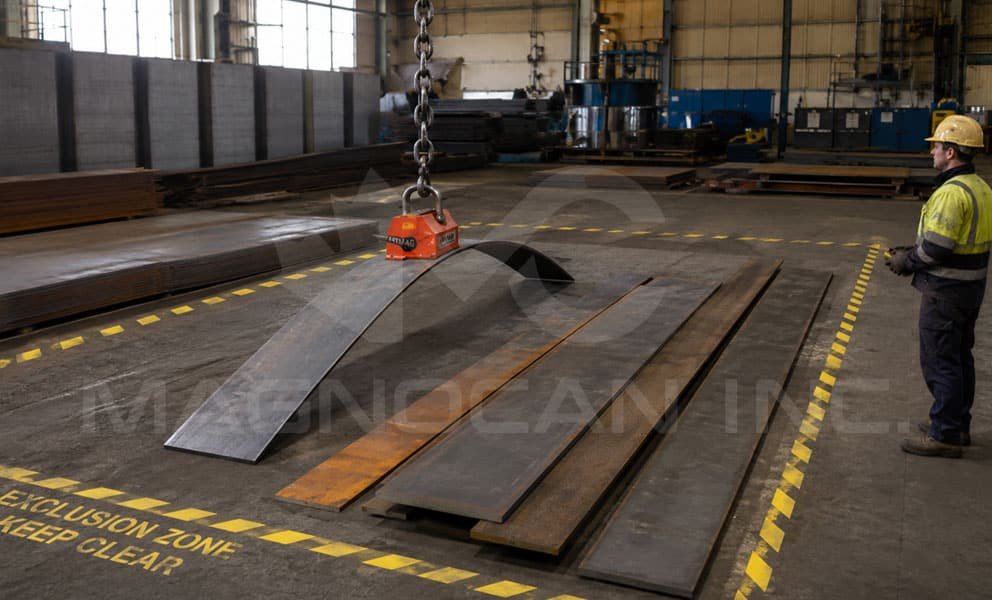
Industrial lifting magnets provide an efficient way to handle ferrous materials such as steel plates, bars, billets, pipes, profiles, and machined components. By using magnetic force to secure a load, lifting magnets can simplify material handling and reduce the need for conventional slings or chains.
However, a lifting magnet is a load-handling device, and safe operation requires more than simply selecting a magnet with a suitable rated capacity.
Load characteristics, surface condition, air gap, magnet condition, operating environment, inspection, operator training, and proper lifting procedures all affect safe performance.
Magnocan helps industrial operations understand magnetic lifting requirements and select, inspect, maintain, and service magnetic equipment according to the application and manufacturer’s requirements.
Understanding how a lifting magnet generates and controls magnetic force is essential for safe and effective operation. Lifting magnets use magnetic fields to create an attractive force between the magnet and ferromagnetic materials such as steel. Depending on the design, the magnetic field may be generated by permanent magnets, electromagnets, or electro-permanent systems.
Learn more about the working principle, types, magnetic circuits, surface contact, and factors that affect lifting capacity in our guide:
How Does a Lifting Magnet Work?
Why Is Lifting Magnet Safety Important?
Unlike a mechanical sling or hook connection, the holding force of a lifting magnet is generated through magnetic contact with the load. A reduction in magnetic performance or an increase in the gap between the magnet and the load can affect the available holding force.
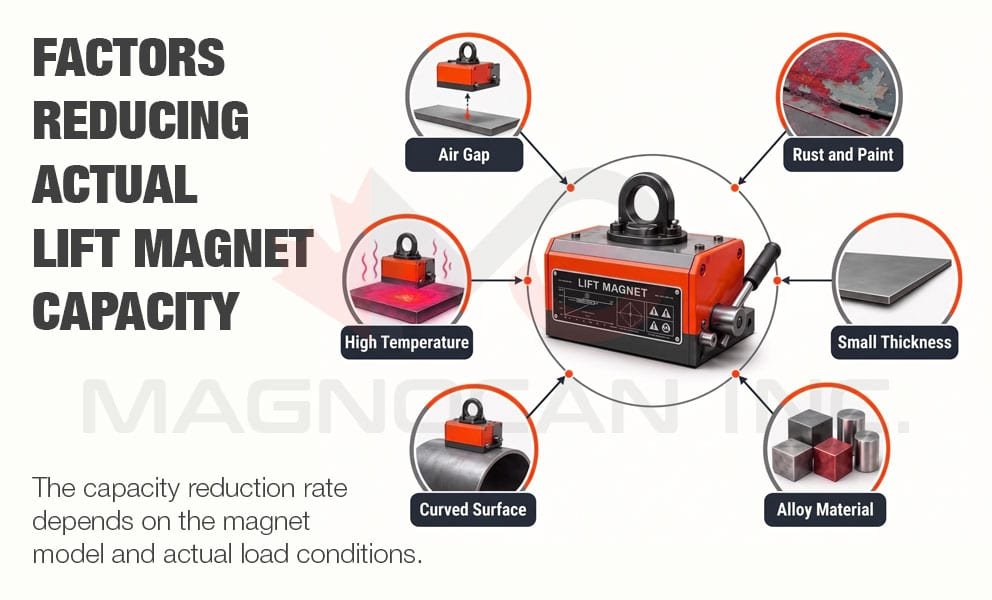
Several factors can influence lifting performance, including:
- Material type and magnetic properties
- Load thickness
- Load shape and geometry
- Surface condition
- Air gap between the magnet and load
- Rust, scale, paint, or contamination
- Load temperature
- Contact area
- Load orientation
- Magnet condition
- Dynamic forces during lifting and movement
For this reason, the capacity marked on a lifting magnet should not automatically be treated as the safe capacity for every application.
The manufacturer’s load chart and operating instructions should be used to determine whether the magnet is suitable for the specific load.
Selecting the Right Industrial Lifting Magnet
Safety begins with selecting equipment that matches the application.
Before choosing a lifting magnet, evaluate:
| Factor | What to Consider |
| Load Type | Plate, bar, billet, pipe, profile, component, or scrap |
| Load Weight | Actual weight of the material |
| Thickness | Material thickness can significantly affect magnetic performance |
| Material | Magnetic properties of the material |
| Surface Condition | Rust, scale, paint, oil, dirt, or other contamination |
| Shape | Flat, cylindrical, irregular, or curved surfaces |
| Centre of Gravity | Position and stability of the load |
| Temperature | Operating temperature of the material |
| Lifting Orientation | Vertical, horizontal, or other lifting conditions |
| Duty Cycle | Frequency and duration of lifting operations |
Long or flexible loads may require multiple lifting points or a suitable lifting beam rather than relying on a single central magnet.
The final configuration should be determined according to the manufacturer’s specifications and the actual lifting application.
Types of Industrial Lifting Magnets
Industrial lifting magnets are available in several configurations, each designed for specific materials, lifting requirements, and operating environments. Selecting the appropriate technology requires evaluating load weight, material properties, surface conditions, lifting orientation, duty cycle, and workplace requirements.
The three main technologies are permanent lifting magnets, electromagnetic lifters, and electro-permanent lifting magnets. Although all use magnetic force to handle ferrous materials, they differ in how the magnetic field is generated, controlled, and maintained.
1. Permanent Lifting Magnets
Permanent lifting magnets use permanent magnetic materials to generate the holding force required to lift compatible ferrous loads. Many industrial models use a mechanical lever to switch the magnetic circuit between holding and release positions.
Because they do not require continuous electrical power to maintain their magnetic field, permanent lifters can be suitable for workshops, machine shops, warehouses, fabrication facilities, and steel-handling operations.
Common applications include:
- Lifting steel plates and sheets
- Handling steel blocks and billets
- Moving compatible bars and machined components
- Loading and unloading machine tools
- Handling ferrous materials in fabrication workshops
Key safety considerations:
- Confirm the rated capacity for the specific load and lifting configuration.
- Inspect the lever, locking mechanism, lifting eye, and contact surface.
- Check the load thickness and magnetic properties.
- Account for air gaps caused by paint, rust, scale, or surface irregularities.
- Confirm that the load geometry is compatible with the magnet’s pole design.
Permanent lifting magnets should only be used within the operating conditions specified by the manufacturer. Their suitability for thin sheets, curved surfaces, or irregular loads must be verified before use.
2. Electromagnetic Lifters
Electromagnetic lifters generate magnetic force by passing electrical current through a coil. They are commonly used in industrial operations that handle large volumes of ferrous material, including steel production, scrap handling, and bulk material processing.
Depending on the design, an electromagnetic lifter may be powered through a fixed electrical connection, a crane-mounted system, or a dedicated power supply.
Common applications include:
- Handling steel plates and heavy steel components
- Moving ferrous scrap
- Loading and unloading steel products
- Handling ferrous materials in foundries and steel mills
- Supporting high-volume material-handling operations
Key safety considerations:
- Verify the electrical supply and control system before operation.
- Inspect cables, connectors, and electrical enclosures.
- Confirm that alarms and other required safety systems function correctly.
- Follow the manufacturer’s procedures for power interruption.
- Verify the availability and condition of any specified backup power system.
- Establish an emergency procedure for safely handling a suspended load during a system fault.
Unlike a permanent magnet, a conventional electromagnetic lifter may lose its holding force if its electrical supply fails. The response to a power failure depends on the specific system design, so backup arrangements and emergency procedures must be established before operation.
3. Electro-Permanent Lifting Magnets
Electro-permanent lifting magnets combine permanent magnetic materials with electrically controlled switching. A short electrical pulse changes the magnetic state, while permanent magnets maintain the holding field during normal operation.
This technology can be useful in automated production lines, robotic handling systems, and applications where reducing continuous power consumption is important.
Common applications include:
- Automated steel-sheet handling
- CNC machine loading and unloading
- Robotic material handling
- Repetitive industrial lifting operations
- Manufacturing processes requiring controlled magnetic activation
Key safety considerations:
- Confirm that the magnet is compatible with the automation and control system.
- Verify the activation and release sequence.
- Check position sensors and status indicators where fitted.
- Ensure that the load is supported before deactivation.
- Follow the manufacturer’s fault-recovery and emergency procedures.
- Verify that the system is suitable for the load geometry and operating cycle.
Although electro-permanent systems can maintain their magnetic field without continuous power, they should not be assumed to be fail-safe in every situation. Safe operation depends on the design, controls, load characteristics, and manufacturer’s instructions.
Comparison of Industrial Lifting Magnet Types
| Feature | Permanent Magnet | Electromagnetic Lifter | Electro-Permanent Magnet |
|---|---|---|---|
| Magnetic field source | Permanent magnetic material | Electrically energized coil | Permanent magnets with electrical switching |
| Continuous power required to maintain holding force | Generally no | Generally yes, unless a specific holding or backup system is provided | Generally no |
| Magnetic switching | Often mechanical | Electrical controls | Electrical pulse |
| Typical applications | Workshops, plates, blocks, components | Steel handling, scrap handling, heavy industrial operations | Automated production and repetitive handling |
| Main considerations | Contact, locking mechanism, load capacity | Power supply, controls, backup and emergency procedures | Control integration, switching sequence, system compatibility |
| Maintenance focus | Mechanical mechanism and magnetic contact surfaces | Electrical system, coil, controls, cables, and structure | Switching system, controls, sensors, and magnetic assembly |
This comparison describes general equipment characteristics. Actual capabilities, safety features, and operating limitations vary by manufacturer and model.
How to Choose the Right Lifting Magnet
Choosing a lifting magnet requires more than comparing rated capacities. The equipment must be suitable for the material, lifting method, and operating environment.
Consider the following factors before selecting a system:
| Selection Factor | Questions to Evaluate |
|---|---|
| Load weight | What is the verified weight of the load? |
| Material | Is the material sufficiently ferromagnetic for the intended application? |
| Thickness | Is the material thick enough for the magnet to achieve its specified capacity? |
| Surface condition | Are paint, rust, scale, or contamination creating an air gap? |
| Load geometry | Is the contact surface flat, curved, irregular, or flexible? |
| Lifting orientation | Will the load be lifted horizontally, vertically, or in another configuration? |
| Operating frequency | Is the application occasional, repetitive, or continuous? |
| Power requirements | Is electrical power available and reliable where required? |
| Automation | Must the magnet integrate with a crane, machine, or robotic system? |
| Safety requirements | What inspections, controls, procedures, and applicable regulations apply? |
For long, flexible, or unevenly shaped loads, the lifting arrangement may require multiple magnets, a lifting beam, or a purpose-designed system. The configuration must be assessed to prevent uneven load distribution, excessive bending, and unintended detachment.
Which Lifting Magnet Is Suitable for Your Application?
The appropriate choice depends on the operational requirements rather than the magnet type alone.
- Permanent lifting magnets may suit applications requiring a relatively simple, self-contained lifting device without continuous electrical power.
- Electromagnetic lifters may suit heavy-duty material handling where electrical controls and the required power infrastructure are available.
- Electro-permanent lifting magnets may suit automated or repetitive operations where controlled switching and reduced continuous power consumption are useful.
These are general application guidelines, not a substitute for an engineering assessment. Before selecting equipment, confirm the manufacturer’s rated capacity and limitations for the actual load and lifting conditions.
Lifting Magnet Selection and Technical Support from Magnocan
Magnocan supports industrial customers evaluating magnetic equipment for material handling and magnetic separation applications. Selecting an appropriate system begins with understanding the load, process requirements, operating environment, and required safety controls.
Depending on the application, technical support may include equipment selection, magnetic performance assessment, inspection, maintenance, refurbishment, troubleshooting, and equipment upgrades.
Need help evaluating a magnetic lifting application? Contact Magnocan to discuss your material, load characteristics, operating conditions, and equipment requirements.
Pre-Operation Lifting Magnet Inspection
Before every lifting operation, the magnetic lifting equipment should be visually inspected to confirm that it is in suitable condition for the intended application. A pre-operation inspection can help identify visible damage, contamination, loose components, or other conditions that could affect lifting performance.
The inspection should cover three key areas: the lifting magnet itself, the lifting connection, and the contact surface between the magnet and the load.
Check the Magnet
Start by inspecting the complete magnet assembly for visible signs of damage or deterioration.
Look for:
- Cracks: Check the housing, lifting points, welds, and other structural areas for visible cracks.
- Deformation: Bent or distorted components may indicate previous overloading, impact, or mechanical damage.
- Corrosion: Excessive corrosion can weaken structural components and affect the condition of the magnetic assembly.
- Damaged components: Check levers, handles, guards, covers, fasteners, and other operating components.
- Loose fasteners: Bolts, nuts, pins, and other securing components should be properly installed and secure.
- Damaged lifting points: Inspect lifting eyes, hooks, shackles, and attachment points for deformation, wear, or cracking.
- Damaged magnetic poles or contact surfaces: The magnetic contact area should be free from significant damage that could prevent proper contact with the load.
- Contamination buildup: Remove excessive metal chips, scale, dirt, oil, or other material that could interfere with magnetic contact.
For permanent lifting magnets, pay particular attention to the activation lever and locking mechanism. The mechanism should operate as intended and reach the required locked position.
For electromagnetic or electro-permanent systems, also inspect relevant electrical components, cables, connectors, controls, indicators, and warning systems according to the manufacturer’s instructions.
Check the Lifting Connection
The connection between the magnet and the crane or lifting equipment is equally important.
Depending on the system, inspect:
- Hooks
- Shackles
- Pins
- Chains
- Lifting eyes
- Bolts
- Welded connections
Look for signs of:
- Cracking
- Excessive wear
- Bending
- Deformation
- Corrosion
- Loose connections
- Missing securing components
The lifting connection must be compatible with the equipment and used within its specified capacity.
If a component appears damaged or its condition is uncertain, do not continue the lifting operation until it has been evaluated by a qualified person.
Check the Magnetic Contact Surface
The condition of the contact surfaces between the magnet and the load is critical to magnetic lifting performance.
The magnet should make appropriate contact with the load according to the manufacturer’s requirements.
Before lifting, remove excessive:
- Metal chips
- Rust scale
- Dirt
- Loose material
- Oil or grease where it affects contact
- Other surface contamination
Also check the load itself for:
- Heavy rust or scale
- Thick paint
- Uneven surfaces
- Curved or irregular sections
- Holes or openings near the contact area
- Surface damage
Why Is the Contact Surface Important?
Magnetic force decreases as the air gap between the magnet and the ferromagnetic load increases.
For example, a layer of rust scale, paint, dirt, or metal debris between the magnet and the load can prevent the magnetic poles from making proper contact. An uneven or curved surface can have a similar effect.
This means that a magnet’s rated capacity should not be considered independently of the actual load condition and contact area.
What If a Problem Is Found?
If the inspection identifies a condition that could affect safe operation, the equipment should not be used until the issue has been properly assessed.
Examples include:
- Cracked structural components
- Deformed lifting points
- Damaged locking mechanisms
- Severely worn components
- Damaged electrical cables
- Unusual operating behaviour
- Significant corrosion
- Damaged magnetic contact surfaces
- Uncertain lifting capacity
The equipment should be removed from service, clearly identified as unavailable for use, and evaluated according to the manufacturer’s procedures and applicable workplace requirements.
| Inspection Area | What to Check |
| Magnet body | Cracks, deformation, corrosion and visible damage |
| Magnetic poles | Damage, contamination and contact condition |
| Operating mechanism | Lever, switch, lock and activation mechanism |
| Lifting point | Hook, eye, shackle, pin and attachment condition |
| Fasteners | Loose, missing or damaged bolts and securing components |
| Electrical system | Cables, connectors, controls, indicators and alarms where applicable |
| Load surface | Rust, scale, paint, dirt, chips and other contamination |
| Load geometry | Flatness, curvature, thickness and suitable contact area |
| Rated capacity | Confirm suitability for the actual load and lifting conditions |
Safe Lifting and Load Movement Procedure
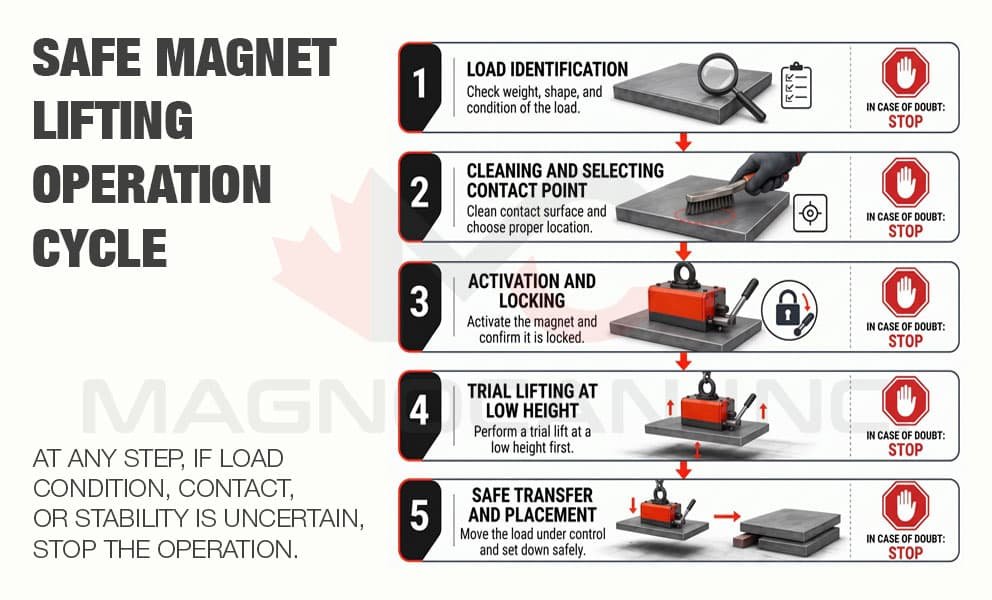
Once the magnet has been correctly positioned and activated according to the manufacturer’s instructions, the load should initially be lifted only a small distance.
This controlled test lift allows the operator to check:
- Load balance
- Magnet contact
- Load stability
- Unexpected movement
- Slipping
- Tilting
If the load moves unexpectedly, immediately lower it to a stable position and investigate the cause.
During Movement
The lifting path should be clear before moving the load.
Operators should:
- Keep people away from the suspended load
- Avoid sudden acceleration and stopping
- Avoid shock loading
- Avoid dragging loads sideways
- Avoid unnecessary swinging
- Keep the load as stable as possible
- Follow the manufacturer’s operating instructions
No person should stand under a suspended load.
The exclusion zone should also account for the possibility of load swing, rotation, or falling material.
Lifting Magnet Safety Checklist
| Before Lifting | During Lifting | After Positioning |
| Check rated capacity | Move smoothly | Place load on a stable surface |
| Inspect the magnet | Avoid sudden movements | Confirm load stability |
| Clean contact surfaces | Keep people clear | Remove risk of rolling or tipping |
| Check lifting connections | Keep load at a controlled height | Deactivate magnet according to procedure |
| Verify load weight | Avoid side loading | Confirm the area is safe |
| Check magnet mechanism | Avoid suspended-load exposure | Record defects if identified |
Common Lifting Magnet Mistakes to Avoid
Several practices can create unnecessary risk during magnetic lifting operations.
Avoid:
- Lifting loads based only on estimated weight
- Assuming rated capacity applies to every load
- Ignoring manufacturer load charts
- Lifting contaminated or unsuitable surfaces without evaluation
- Using a flat magnet on unsuitable curved loads
- Lifting multiple plates without confirming suitability
- Dragging suspended loads
- Allowing people under suspended loads
- Continuing to use damaged equipment
- Ignoring warning alarms
- Bypassing safety devices
- Using equipment outside its rated application
- Leaving suspended loads unattended
Production pressure should never be used as a reason to continue an operation when the equipment or load condition is uncertain.
Frequently Asked Questions
Is the rated capacity of a lifting magnet always the maximum load it can lift?
No. Rated capacity depends on the conditions defined by the manufacturer. Material type, thickness, surface condition, air gap, load geometry, temperature, and lifting configuration can affect actual performance.
Can a lifting magnet be used on painted or rusty steel?
It depends on the equipment and the manufacturer’s specified operating conditions. Paint, rust, scale, and other contamination can create an air gap and reduce magnetic holding force.
How often should a lifting magnet be inspected?
A pre-use inspection should be performed according to the equipment manufacturer’s instructions and workplace procedures. Periodic inspections should also be scheduled based on equipment usage, operating conditions, manufacturer recommendations, and applicable requirements.
Can people stand under a magnetic lifting load?
No. Personnel should not stand underneath a suspended load or within an area where they could be struck by a falling or swinging load.
What should I do if a lifting magnet loses performance?
Stop the operation and place the load in a safe position if possible. The magnet should be inspected and its magnetic performance evaluated before returning it to service. Depending on the condition, repair, refurbishment, re-magnetizing, or replacement may be appropriate.
Conclusion
Safe operation of industrial lifting magnets depends on the complete lifting system—not magnetic strength alone.
The magnet must be appropriate for the load, the actual lifting conditions must be understood, contact surfaces must be suitable, equipment must be inspected and maintained, and operators must follow documented procedures.
For Canadian industrial operations, combining proper equipment selection, inspection, preventive maintenance, operator training, and application-specific procedures can help create a more controlled and reliable material-handling process.
If you are evaluating a magnetic lifting application, need to assess existing equipment, or require magnetic equipment service, Magnocan can help you determine the appropriate next step for your application.