




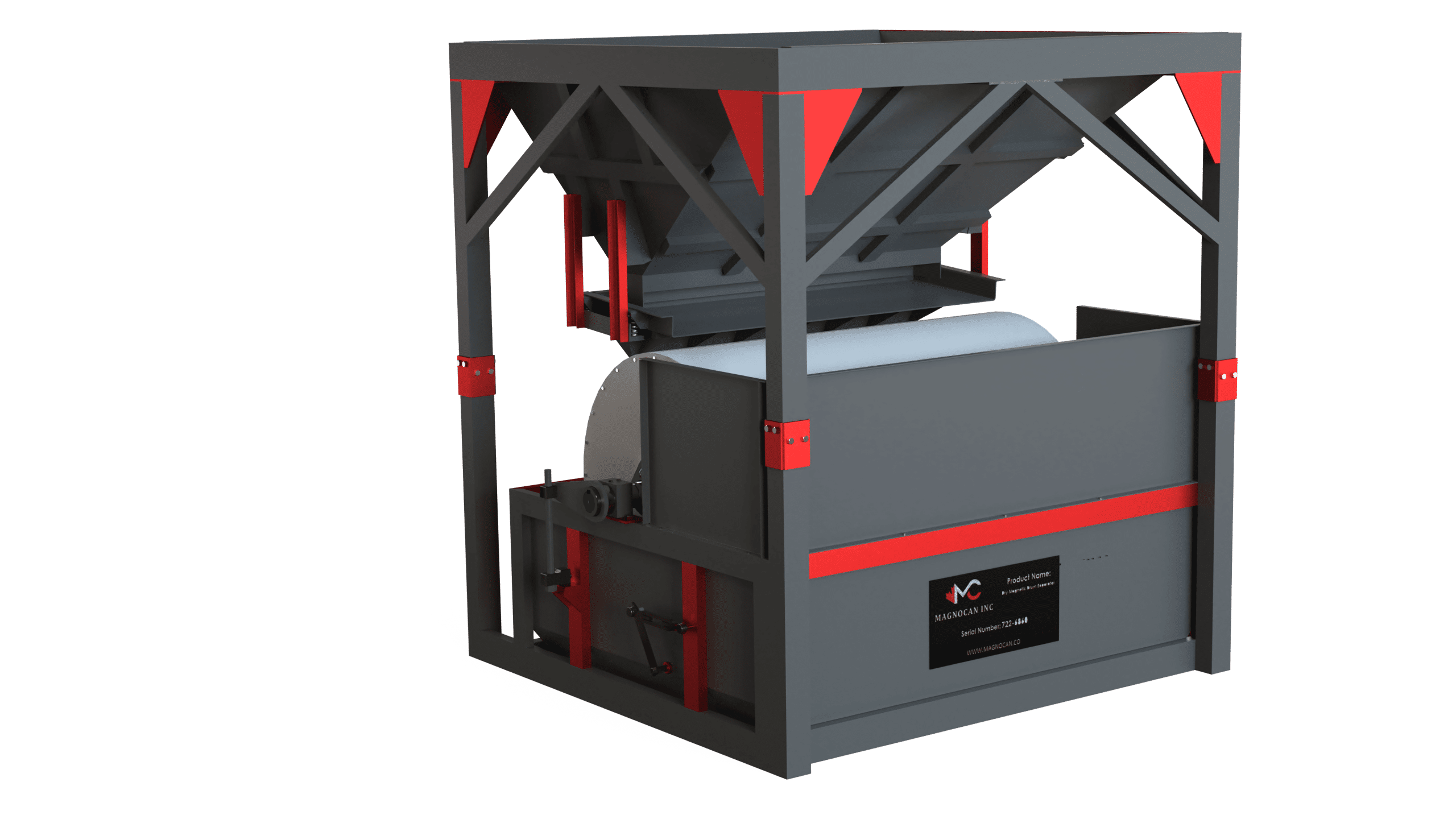
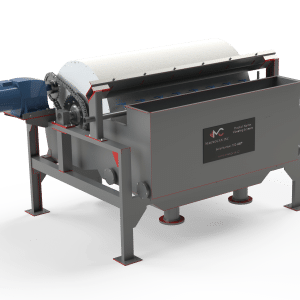
Magnocan Inc. provides permanent dry drum magnetic separators designed to remove ferrous contaminants and recover magnetic materials from dry bulk processing streams. These systems use a permanent magnetic drum to attract magnetic particles while allowing non-magnetic materials to continue through the process.
Suitable for applications in mining, recycling, aggregates, and industrial processing, dry drum magnetic separators can help improve material purity, recover valuable magnetic fractions, and protect downstream equipment from unwanted ferrous particles.
Unlike wet drum separators, dry magnetic drum systems process materials without requiring water. This makes them a practical option for applications where feed materials are handled in dry form or where water use should be minimized.
Permanent Dry Drum Magnetic Separators for Canadian Industry
Magnocan supplies magnetic separation solutions for Canadian industrial operations that require reliable separation of ferrous materials from dry bulk products.
Permanent dry drum magnetic separators can be considered for applications involving:
- Mining and mineral processing
- Aggregate production
- Recycling and material recovery
- Industrial minerals
- Dry ore processing
- Powder and bulk material handling
- Ferrous contamination removal
The appropriate separator depends on the magnetic properties of the material, particle size distribution, feed rate, moisture content, and required separation performance.
How Does a Permanent Dry Drum Magnetic Separator Work?
A permanent dry drum magnetic separator uses a rotating drum with a stationary permanent magnet assembly inside.
As dry material moves toward and across the drum, magnetic particles are attracted to its surface. Non-magnetic particles follow a different trajectory and are discharged separately.
The rotating drum transports captured magnetic material away from the main product stream. Once the particles move beyond the effective magnetic zone, they are released into a separate discharge area.
This continuous process allows the equipment to separate magnetic and non-magnetic fractions without requiring water or continuous electrical power to generate the magnetic field.
Main Separation Stages
- Material Feeding: Dry bulk material is introduced to the separation zone.
- Magnetic Attraction: Magnetic particles respond to the permanent magnetic field.
- Material Separation: Magnetic and non-magnetic fractions follow different discharge paths.
- Magnetic Material Discharge: Captured particles are released into a separate collection area.
- Continuous Operation: The drum continues rotating as new material enters the system.
Actual separation efficiency depends on feed characteristics, magnetic properties, particle size, material distribution, and equipment configuration.
Key Features of Permanent Dry Drum Magnetic Separators
Permanent Magnetic System
The permanent magnet assembly generates the magnetic field without requiring continuous electrical power for magnetization.
Dry Processing Design
The separator handles dry bulk materials without requiring water, making it suitable for dry processing circuits and applications where water consumption is a concern.
Continuous Material Separation
The rotating drum supports continuous separation of magnetic particles from the main material stream.
Heavy-Duty Construction
Industrial drum separators can be configured for demanding processing environments. Construction materials and protective features should be selected according to the feed and operating conditions.
Integration With Existing Equipment
Dry drum separators can be incorporated into suitable material handling and processing systems. Installation requirements depend on the feed arrangement, available space, and process layout.
Application-Specific Configuration
Magnetic field configuration, drum dimensions, feed rate, and separation arrangement should be selected according to the material and the desired separation result.
Important: Permanent magnetic field strength is generally determined by the magnet assembly design rather than adjusted in the same way as an electromagnetic system. Separation performance may instead be optimized through equipment configuration and operating conditions.
Benefits of Dry Drum Magnetic Separation
Improved Material Purity
Removing unwanted magnetic particles can improve the quality of dry processed materials.
Recovery of Magnetic Materials
Dry drum separators can help recover magnetic fractions from selected mineral and recycling streams.
Reduced Water Consumption
Because the separation process handles dry material, it does not require process water for the magnetic separation stage itself.
Downstream Equipment Protection
Removing ferrous contaminants can help reduce the risk of damage, wear, or operational disruption to downstream equipment.
Continuous Processing
A properly configured system can operate continuously as part of an industrial production line.
Potentially Lower Magnetization Energy Requirements
Permanent magnet systems do not require continuous electrical power to generate their primary magnetic field. Total equipment energy consumption still depends on the drum drive and associated process equipment.
Applications of Permanent Dry Drum Magnetic Separators
Mining and Mineral Processing
Dry drum magnetic separators may be used to separate magnetic minerals from non-magnetic material in suitable dry processing applications.
Potential applications include:
- Dry ore processing
- Magnetic mineral recovery
- Mineral upgrading
- Selected iron-bearing material separation
Recycling and Material Recovery
Magnetic separation can help recover ferrous fractions from compatible dry material streams, supporting material recovery and recycling processes.
Aggregate Processing
In suitable applications, dry magnetic separation can remove unwanted magnetic particles from dry aggregates and mineral products.
Industrial Minerals
Dry drum separators may be considered where magnetic contaminants need to be removed from industrial mineral products without introducing water into the process.
The suitability of dry separation depends on the feed’s magnetic properties, particle size, moisture level, and the required product quality.
Permanent Dry Drum Magnetic Separator Specifications
Equipment specifications should be confirmed for the selected model and application.
| Parameter | Description |
|---|---|
| Magnet Type | Permanent magnetic assembly |
| Separation Method | Dry magnetic separation |
| Feed Material | Dry bulk materials |
| Target Material | Magnetic particles and ferrous contaminants |
| Operation | Continuous, depending on system configuration |
| Drum Dimensions | Selected according to capacity and application |
| Magnetic Field | Based on magnet assembly design |
| Feed Rate | Determined by material characteristics and equipment configuration |
| Particle Size | Application- and model-dependent |
| Moisture Requirements | Feed must be suitable for dry separation |
| Installation | Integrated into an appropriate material handling system |
| Maintenance | Routine inspection and preventive maintenance recommended |
How to Choose the Best Permanent Dry Drum Magnetic Separator
The best permanent dry drum magnetic separator is the one that meets the requirements of your specific application. A separator suitable for coarse mineral material may not provide the same results with fine powders or mixed recycling streams.
Before selecting equipment, evaluate the following factors:
- Material composition: Identify the magnetic and non-magnetic fractions.
- Magnetic properties: Determine the magnetic response of the target particles.
- Particle size: Consider the full size distribution of the feed.
- Moisture content: Excess moisture may cause particles to stick together and interfere with dry separation.
- Feed rate: Match the separator to the required throughput.
- Separation objective: Clarify whether the priority is product purification or magnetic material recovery.
- Installation layout: Consider available space, feed distribution, and discharge arrangements.
- Maintenance access: Ensure that the equipment can be inspected and serviced safely.
- Total operating cost: Consider energy use, wear, maintenance, and production requirements.
For challenging applications, representative material testing may help determine whether a dry drum separator is suitable and which configuration should be evaluated.
Permanent Dry Drum Magnetic Separator Price
The permanent drum magnetic separator dry price depends on equipment size, magnetic configuration, capacity, construction, and application requirements.
There is no single price that applies to every dry drum magnetic separator. Important cost factors include:
| Price Factor | Impact on Equipment Cost |
|---|---|
| Drum Size | Larger drums may require more materials and a different mechanical configuration. |
| Magnetic Assembly | Magnet design and magnetic performance requirements affect equipment configuration. |
| Processing Capacity | Higher throughput may require a larger separation area and supporting equipment. |
| Feed Characteristics | Particle size, abrasiveness, and material properties influence the required design. |
| Construction Materials | Material selection depends on operating conditions and durability requirements. |
| Drive System | Motor, gearbox, and drive requirements affect the overall configuration. |
| Custom Engineering | Special dimensions or integration requirements may affect the final quotation. |
| Installation | Mounting, conveyors, feed systems, and site work may add to the project cost. |
| Transportation | Shipping and delivery requirements affect the total investment. |
| Service and Spare Parts | Maintenance support and spare parts should be considered in lifecycle costs. |
When comparing prices, review the complete equipment specification and included components rather than choosing solely on the initial purchase cost.
Request a Dry Drum Magnetic Separator Quote in Canada
To receive a relevant quotation, prepare the following information:
- Material type and composition
- Particle size distribution
- Feed rate or required capacity
- Moisture content
- Target magnetic material
- Required product purity or recovery
- Installation and process requirements
This information helps the technical team evaluate the application and identify a suitable equipment configuration.
Permanent vs. Electromagnetic Dry Drum Separators
Permanent and electromagnetic systems generate their magnetic fields differently. The appropriate choice depends on process requirements and the degree of magnetic field control needed.
| Feature | Permanent Dry Drum | Electromagnetic Dry Drum |
|---|---|---|
| Magnetic Field Source | Permanent magnets | Electrically energized coils |
| Continuous Power for Magnetization | Not required | Generally required |
| Field Adjustment | Primarily determined by magnet design | Can be controlled through electrical input, depending on design |
| Energy Consumption | Includes drum drive and associated equipment | Includes drum drive and electromagnetic power requirements |
| Maintenance | Mechanical inspection and magnet assembly assessment | Mechanical and electrical system maintenance |
| Selection Factors | Feed properties, required separation, capacity | Feed properties, field control, capacity, and system design |
Neither technology is automatically best for every application. Selection should be based on the required separation performance, material characteristics, and overall operating conditions.
Maintenance of Permanent Dry Drum Magnetic Separators
Routine maintenance helps maintain reliable operation and identify developing problems.
A maintenance program may include:
- Inspecting the drum shell for damage and wear
- Checking bearings and rotating components
- Inspecting the drive system and gearbox
- Checking fasteners and mounting points
- Monitoring unusual vibration or noise
- Inspecting feed and discharge arrangements
- Removing material buildup when required
- Assessing magnetic performance when appropriate
- Following the manufacturer’s inspection and service recommendations
Maintenance intervals should reflect the equipment design, operating environment, material abrasiveness, and production schedule.
Why Choose Magnocan?
Magnocan focuses on magnetic separation solutions designed around industrial process requirements.
Selecting a separator involves more than comparing magnetic field strength or equipment price. Material properties, feed conditions, separation objectives, and integration with existing machinery all influence the result.
Magnocan can support industrial applications involving:
- Magnetic separator selection
- Magnetic separation equipment evaluation
- Equipment inspections
- Preventive maintenance
- Gauss testing
- Magnetic field assessment
- Equipment troubleshooting
- Replacement parts
- Equipment upgrades
Request a Quote for a Permanent Dry Drum Magnetic Separator
Looking for a permanent dry drum magnetic separator for a Canadian industrial application?
Contact Magnocan with your material details, required capacity, particle size distribution, and separation objective. Our team can review your requirements and help identify the appropriate next steps for equipment selection.
Request a Quote to discuss your dry magnetic separation application.
Frequently Asked Questions
What is a permanent dry drum magnetic separator?
A permanent dry drum magnetic separator uses a rotating drum and a permanent magnetic assembly to separate magnetic particles from dry bulk materials without requiring process water.
What is the price of a permanent dry drum magnetic separator?
The price depends on drum size, magnetic configuration, capacity, construction materials, feed characteristics, and installation requirements. A project-specific quotation is needed for an accurate cost.
What is the best permanent dry drum magnetic separator?
The best separator depends on the material’s magnetic properties, particle size, moisture content, throughput, and separation objective. Equipment should be selected based on the specific application rather than price alone.
Can a dry drum magnetic separator operate without water?
Yes. A dry drum magnetic separator is designed to process suitable dry materials without using water in the magnetic separation stage.
What materials can a dry drum magnetic separator process?
Depending on the configuration, it may process selected ores, minerals, aggregates, recycling materials, and other dry bulk products containing magnetic particles.
Does a permanent drum magnetic separator require electricity?
The permanent magnetic assembly does not require continuous electrical power to generate its primary magnetic field. The rotating drum and associated equipment may still require electricity.
How do I choose between a dry and wet drum magnetic separator?
Dry separators process suitable dry bulk materials, while wet drum separators process slurries. Feed characteristics, moisture, particle size, separation objectives, and downstream process requirements should guide the choice.
Get in Touch
Interested in improving your material processing with effective magnetic separation? Get in touch with Magnocan Inc’s Technical Expert Team for Free Specialized Consultation. We’ll help you find the perfect Drum Magnetic Separator Dry Type for your operation’s needs.
Warranty Information
Magnocan Inc’s Drum Magnetic Separator Dry Type comes with a 1-year warranty, ensuring reliable support and quality performance for your operations.
Optimize your dry material processing with Magnocan Inc’s high-performance Drum Magnetic Separator today!
Reviews
Clear filtersThere are no reviews yet.